What do AI music statistics 2026 actually show?
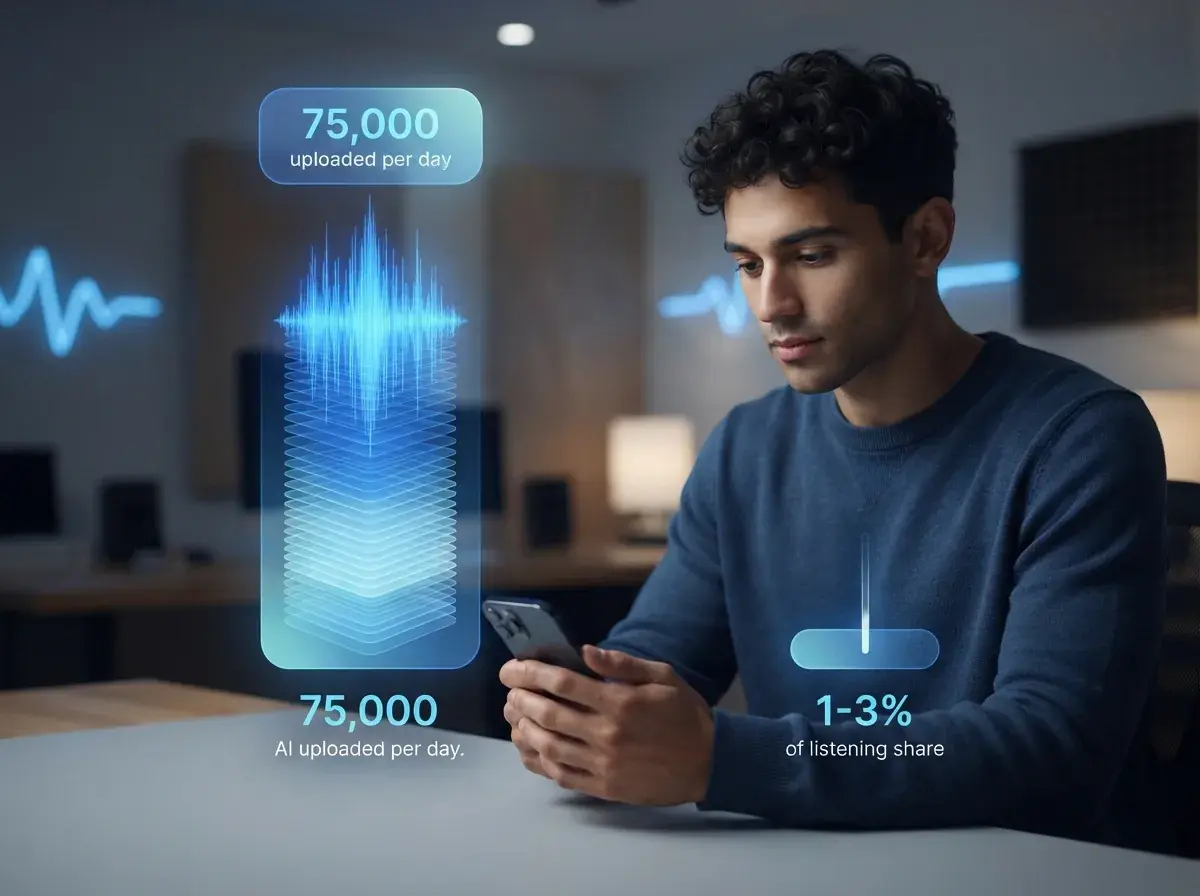
AI music statistics 2026 show three clear things: the market is expanding, AI-made uploads are surging, and listening share is still far below upload share. The numbers move in two directions at once. On the business side, Market.us estimated the global AI in music market at USD 5.20 billion in 2024, and many 2026 forecasts build from that base toward a much larger category. On the creator side, LANDR reported that 87% of surveyed artists already use AI somewhere in their workflow, while 29% use AI song creation tools for at least part of the process. On the listener side, Deezer reported that 44% of new music uploads are now AI-made, but only 1-3% of listening goes to that music. Deezer also said its platform is seeing 75,000 AI songs uploaded per day, and 85% of the streams tied to those uploads are fraud. The simple read is this: supply is growing much faster than demand. If you want the wider industry context, see the state of music report 2026.
The market behind AI music stats 2026
The market story is bigger than music tools alone because AI music sits inside a much larger entertainment economy. PricewaterhouseCoopers said global entertainment and media revenue reached US$2.8 trillion in 2023, up 5% from the prior year. That matters because AI music tools compete for budget inside creator software, streaming, social video, gaming, and advertising. For music specifically, the key pattern is category expansion. AI is no longer one niche product type. It now spans song creation, lyric writing, stem separation, vocal removal, soundtrack work, sync support, wellness audio, and education apps. That broader tool landscape helps explain why the market keeps attracting investment and why consolidation is likely as larger media and software firms buy smaller specialists. A useful way to read music statistics is to separate valuation from usage. A rising market size does not mean every AI-made song gets heard. It means buyers, platforms, and creators see enough practical value to keep spending. For a deeper breakdown of segments and forecasts, read the AI music generation market.
How musician workflows changed in 2026
AI music adoption statistics point to a workflow shift, not a full replacement story. Artists are using more tools across more tasks, but they are still deciding where AI fits best. LANDR surveyed 1,241 creators from its community in 2025. The fieldwork ran from September 30th - October 6th 2025, participants had to be at least 16, and the questionnaire covered more than 30 items and 52 possible AI use cases. In that survey, 69% said they use more AI tools now than a year earlier. Among people who increased usage this year, 90% expect to increase again next year. LANDR also found that 30% did not increase their adoption, and within that group only 1 in 4 wants to use more going forward. Those figures show two things. First, adoption is real and still rising. Second, hesitation has not disappeared. The practical split is between creators using AI to speed up drafts, edits, stems, and ideas, and listeners who still respond most to human taste, identity, and promotion. For creators on the drafting side, an AI Music Generator such as On Music AI turns those ideas into finished tracks fast. For historical context on how this shift developed, see the history of AI music.
How to read AI music trends without getting fooled by upload hype
You should read AI music trends through four lenses: uploads, listening, creator adoption, and regulation. If you only look at one, you will get the wrong picture.
Step 1: Check upload volume first
Deezer's report of 75,000 AI songs uploaded per day tells you the supply side is saturated. This is the clearest signal for platform pressure, spam risk, and discovery problems.
Step 2: Compare uploads with actual listening
Deezer said 44% of new music is AI, but only 1-3% of listening goes to it. That gap shows that upload share is not the same as audience demand.
Step 3: Look at creator behavior
LANDR found 87% already use AI somewhere and 29% use AI song creation tools. That tells you AI is becoming normal in production even if fully AI listening stays modest.
Step 4: Watch legal and licensing changes
Settlements, training disputes, and labeling rules now shape product design as much as model quality. If you want adjacent signals on genres, platforms, and audience habits, read music trends 2026.
What AI music statistics 2026 mean for rights, royalties, and the next year
AI music statistics 2026 mean the biggest pressure points are now legal clarity, royalty economics, and trust. Growth is no longer the only question. The harder one is who gets paid, who gives permission, and how platforms separate real listening from manipulation. Licensing is moving toward stricter boundaries around training data, voice use, and commercial release rights. That does not stop AI music, but it does make provenance more important. Expect more emphasis on documented inputs, clearer platform rules, and tool categories that avoid risky claims. Royalties are also under pressure because a surge in low-listened uploads can crowd distribution systems without creating equal demand. That is one reason the gap between uploads and listening matters so much: if listeners cannot easily tell what is synthetic, platforms need stronger labeling and fraud controls. For creators, the next year looks practical. AI will stay useful for drafts, lyrics, instrumentals, and editing, while audience connection, artist identity, and trusted release workflows remain the real value drivers. The numbers support expansion, but they also support tighter standards.
Sources and further reading
The statistics in this report are drawn from industry and market-research sources, including PricewaterhouseCoopers, Market.us, Ditto Music, UK Music, Goldmedia. Figures reflect the most recent data available at the time of writing.